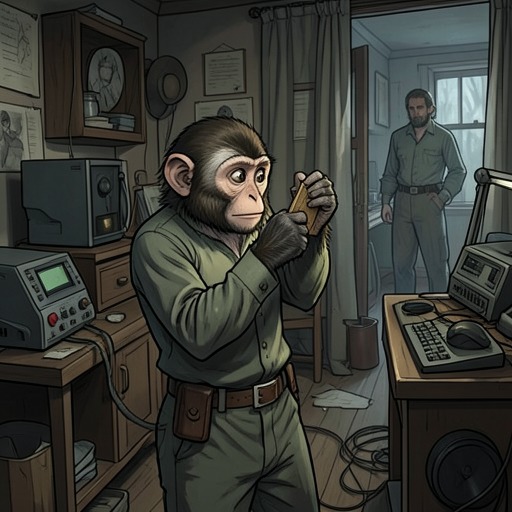
Suginami Monkeys
Blind Willow, Sleeping WomanThe Shinagawa monkey is a talking monkey whose compulsion to steal human names brings him into the lives of Mizuki and Yuko. Caught in a sewer hideout beneath Takanawa and bound to a chair in a storage room, he confesses to taking the name tags from Mizuki’s apartment and to having pursued Yuko’s name out of love. His account turns an apparent theft into something more complicated: he describes it as an uncontrollable sickness, but also believes that names can carry darkness—and that taking Yuko’s name might have lifted some of the burden that preceded her suicide.
Identity and Capture
The monkey is large for a monkey, though smaller than an adult human and larger than an elementary-school student. His hair is longer than usual and flecked with gray; his age is difficult to determine, but he is plainly no longer young. When Mizuki enters the storage room, he looks briefly at her and then lowers his gaze. His arms and legs have been tied to a wooden chair with thin cord, and his long tail lies on the floor.
Mrs. Sakaki explains that the monkey stole the name tags from Mizuki’s apartment. The name tags had disappeared around the time Mizuki began forgetting her own name, about a year earlier. Seeing the captive monkey brings back Yuko’s warning that she did not want a monkey running off with her tag. Mizuki realizes that Yuko had known about the danger; what once seemed like a joke now signals knowledge of the theft.
The Sakakis’ discovery follows the monkey’s concealment underground. Mrs. Sakaki says he had been hiding in Shinagawa’s sewers, and her husband, the Public Works section chief, arranged for younger colleagues to catch him. Sakurada, one of those colleagues, says the monkey used a hideout beneath Takanawa as a base for foraging throughout Tokyo. The capture places the monkey’s private compulsion inside the city’s overlooked infrastructure: his refuge is beneath the streets, while the objects he seeks belong to people living above them.
The Theft and Its Compulsion
The monkey speaks in a low but spirited voice with an almost musical quality, surprising Mizuki, who had not expected him to talk. His first apology is for the name tags; his second is for taking two bananas from Mizuki’s table during the same break-in. He says he had not meant to steal anything else, but was hungry and could not resist them. The small confession makes the episode tangible: the invasion of the apartment involved both a deliberate search for names and an impulsive act of hunger.
Asked why he steals names, he describes the behavior as a sickness. A name that attracts him—especially a person’s name—becomes something he feels compelled to possess. He sneaks into homes to take such names, knows that doing so is wrong, and says he cannot control himself. His account does not excuse the violation, but gives it a defined pattern: the theft is selective, directed toward names that exert a particular attraction, rather than indiscriminate stealing.
He confirms that he had tried to enter the women’s dormitory to take Yuko’s name tag. He says he was deeply in love with Yuko, more attracted to her than he had ever been to anyone, but could not make her his. As a monkey, he found that frustration impossible to bear and decided that possessing her name would be enough. Before he could carry out the plan, Yuko died. The tag therefore represents more than the object of a theft: it is the substitute possession he imagined could bridge the distance between his desire and the person he could not have.
The City Beneath the Streets
The monkey’s account of his hiding place gives the sewer another meaning. He says monkeys have little room to live in the city: there are few trees and shady daytime places, and people try to catch them when they come aboveground. Children throw things or shoot at them with BB guns; large dogs chase them; television crews shine spotlights when they try to rest in trees. In his telling, retreat underground is a response to continual disturbance and pursuit.
This appeal for forgiveness complicates his position without cancelling the harm he caused. The monkey acknowledges that he has troubled humans and asks not to be killed. He insists that his actions may also have a beneficial side: when he takes a name, he says, he can remove negative elements clinging to it. His account moves from an urban animal’s lack of shelter to a claim about unseen emotional burdens, linking physical refuge beneath Tokyo with the darkness he says can cling to a person’s name.
Yuko’s Name and the Ending
The monkey applies his belief about names directly to Yuko. He says that if he had managed to steal her name, he might have taken away some of the darkness hidden within her and carried it, along with the name, back to the underground world. He cannot know whether this would have changed what happened, and his statement remains a possibility rather than a proven explanation of Yuko’s suicide. Its importance lies in the way it joins his desire to possess her name with a wish—however belated—to relieve her suffering.
When Mizuki says goodbye, she gives the monkey Yuko’s name tag, telling him that he should have it because he liked Yuko. He admits that he did. The gesture reverses the earlier theft: the tag is no longer taken in secret from a home, but entrusted to him by Mizuki. His response does not undo Yuko’s death or settle whether his theory about names is true. It gives the encounter a quiet ending in which an object associated with loss passes into the hands of the one who had wanted it, now openly and through another person’s choice.
The monkey’s story holds together several meanings without resolving them into a single verdict. He is a trespasser who takes what is not his, a creature driven by a compulsion he says he cannot govern, and an animal describing the pressures that drive monkeys out of the city’s visible spaces. His claim that stolen names can carry away darkness makes his habit sound at once invasive and almost redemptive, while Yuko’s death leaves that claim untestable. The returned tag preserves this uncertainty: it restores no life and erases no past, but turns the monkey’s frustrated possession into an acknowledged bond with Yuko’s memory.